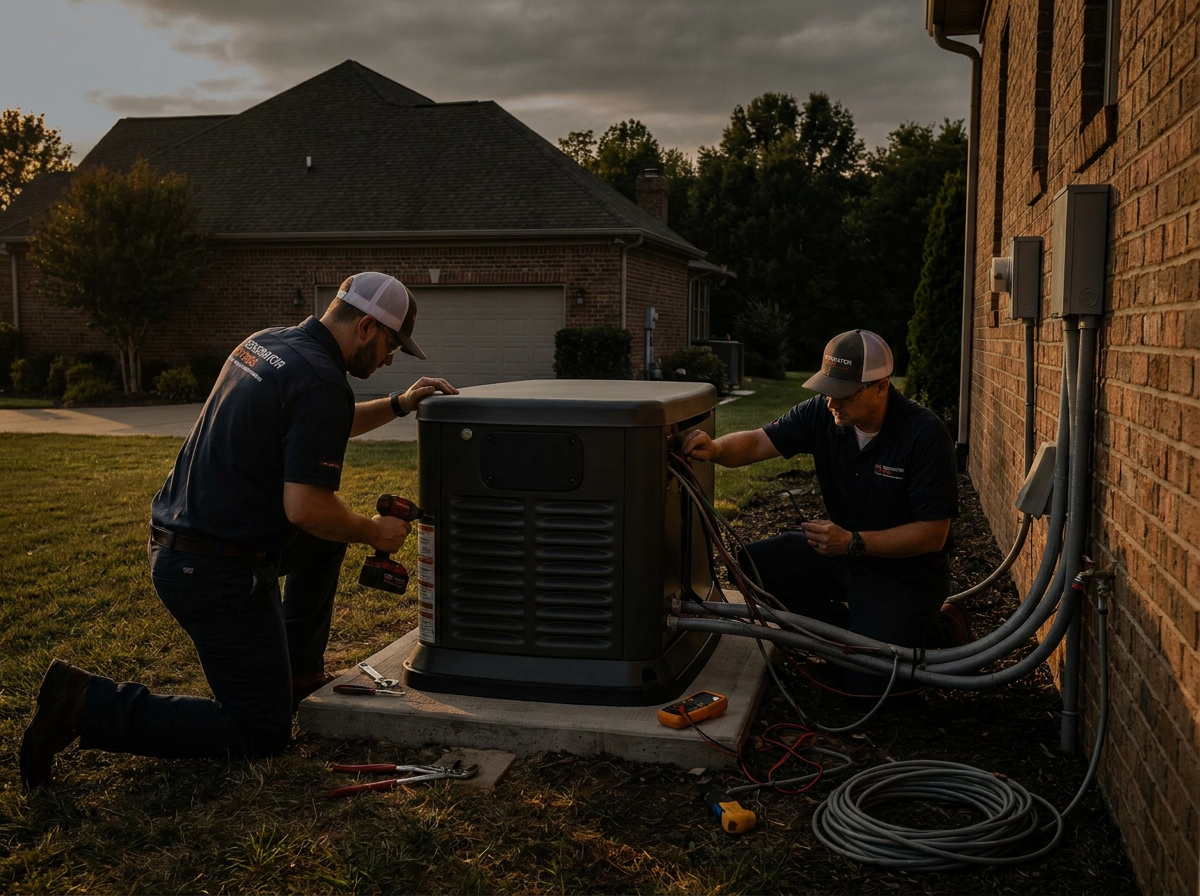
Transfer Switch Installation
Automatic & Manual Transfer Switches — Code-Compliant, Utility-Approved, Built to Last
The link between your generator and your home. Licensed installation, all permits filed, utility coordination included — at nonprofit dealer cost pricing.
Never Connect a Generator Without a Transfer Switch
Plugging a generator directly into a wall outlet (back-feeding) is illegal in every state, can destroy your generator and appliances, and poses a lethal electrocution hazard to utility workers on what they believe are de-energized power lines. The NEC requires an approved transfer switch or interlock device on every generator-to-home connection — no exceptions.
Automatic vs. Manual — Which Do You Need?
Both types are code-compliant and safe. The right choice depends on your generator type, your priorities, and your budget.
Automatic Transfer Switch (ATS)
Continuously monitors utility power. The moment an outage is detected, it starts your standby generator and transfers your home's circuits in under 30 seconds — with no action required from you, even if you are away or asleep.
- ✓No manual intervention required
- ✓Activates in seconds — even during the night
- ✓Included in all standby generator installations
- ✓Load management features available
- ✓Monitors utility voltage and frequency
Manual Transfer Switch / Interlock Kit
After starting your portable generator, you flip the transfer switch to disconnect from utility power and connect generator power to your panel. Interlock kits are a lower-cost alternative that fit directly on your existing breaker panel.
- ✓Works with any portable generator
- ✓Lower equipment cost than ATS
- ✓Physically prevents back-feed — legally compliant
- ✓Interlock kits fit most standard breaker panels
- ✓Installation typically completed in half a day
What Our Installation Covers
Every transfer switch installation is handled start to finish — no subcontractors, no permit headaches, no utility calls on your end.
Site Assessment
- ✓Panel evaluation and load analysis
- ✓Generator output compatibility check
- ✓Code and utility requirements review
- ✓Written quote before work begins
Permits
- ✓Electrical permit applications filed
- ✓HOA notifications where required
- ✓Permit tracking and follow-up
- ✓Inspection scheduling with city
Installation
- ✓Transfer switch or interlock install
- ✓Generator-to-panel wiring
- ✓All conduit and wiring work
- ✓Weatherproof connections
Coordination & Testing
- ✓Utility interconnection scheduling
- ✓Load testing under real conditions
- ✓Simulated outage transfer test
- ✓Owner operation walkthrough
Code Compliance — Why It Matters
A transfer switch installed by an unlicensed contractor or without a permit creates serious legal and insurance liabilities. Every installation we complete meets or exceeds these standards.
National Electrical Code (NEC)
Article 702 of the NEC governs optional standby systems including generators and transfer switches. Our installations comply with the current NEC and all applicable local amendments.
Local Permits & Inspections
We file all required electrical permits and schedule inspections with your local jurisdiction. A passed inspection creates a public record that protects your homeowner's insurance coverage.
Utility Interconnection Rules
Each utility company has specific interconnection requirements for generators. We contact your utility directly and have established relationships with all providers in our service territories.
Transfer Switch — Frequently Asked Questions
What is the difference between an automatic and manual transfer switch?
An automatic transfer switch (ATS) monitors your utility power continuously and activates your standby generator within seconds of an outage — with no action required from you. A manual transfer switch requires you to physically flip the switch after starting your generator. Automatic switches are paired with standby generators; manual switches or interlock kits are typically used with portable generators. Both types physically prevent back-feed to the utility grid.
How much does transfer switch installation cost?
Transfer switch installation costs depend on the type (automatic vs. manual), the size of your electrical panel, and whether any service upgrades are required. Because we are a 501(c)(3) nonprofit, all customers receive dealer cost pricing on equipment and labor — typically $500 to $1,500 less than commercial electricians. We provide a firm written quote before any work begins.
How long does transfer switch installation take?
A manual transfer switch or interlock kit installation for a portable generator typically takes 2 to 4 hours. An automatic transfer switch installed as part of a full standby generator installation is completed during the same 1 to 2 day installation visit. Permits are generally required for both types — we handle the applications on your behalf.
Is a transfer switch required by code?
Yes. The National Electrical Code (NEC) and virtually all local jurisdictions require a properly installed transfer switch or approved interlock device whenever a generator is connected to a home's wiring. Back-feeding power through the utility meter without a transfer switch is illegal, can destroy your generator, and poses a lethal hazard to utility workers.
Can a transfer switch be installed on any generator?
Yes. Transfer switches are matched to your generator's output capacity and your electrical panel — not to a specific generator brand. Our technicians install automatic transfer switches for Generac, Cummins, Briggs and Stratton, and other standby brands, and can add manual transfer switches or interlock kits for any portable generator regardless of brand or age.
What is the difference between a transfer switch and an interlock kit?
Both prevent back-feed to the utility grid. A transfer switch is a dedicated panel managing the switching between utility and generator power. An interlock kit is a mechanical device fitted to your existing breaker panel that prevents both breakers from being on simultaneously. Interlock kits are typically less expensive and work well with portable generators. Our technicians will recommend the right solution for your setup.
Do you handle utility coordination for transfer switch installations?
Yes. We contact your utility company directly to schedule the interconnection inspection and any required utility approval. We have strong working relationships with all utility providers in our service areas — Kansas City, Springfield, Oklahoma City, Tulsa, and Tampa — which means faster approvals and fewer delays.
Get Your Transfer Switch Installed the Right Way
Code-compliant. Utility-approved. Permitted and inspected. Schedule a free assessment and we will have a firm quote to you the same day.
Prefer to text? Reach us at 816-785-1268 — Missouri, Kansas, Oklahoma, and Florida.