Generator Carbon Monoxide Safety: What Every Owner Must Know
Updated July 2026 • 8 min read
Critical Safety Warning
Carbon monoxide from generators is colorless, odorless, and can kill within minutes. Each year, dozens of Americans die from generator-related CO poisoning — most during or after storms and power outages. Every generator owner must understand these safety rules before operating any generator.
Carbon monoxide (CO) is the deadliest hazard associated with generator use. The gas is invisible, has no odor, and incapacitates its victims before they realize what is happening. Understanding and following CO safety rules is not optional — it is a matter of life and death.
What Makes Generator Carbon Monoxide So Dangerous
Generators produce CO as a byproduct of combustion — every gasoline, propane, diesel, and natural gas engine produces it. The danger is that CO has no smell, no color, and no taste. By the time a person realizes something is wrong, CO may already have displaced enough oxygen in their blood to prevent normal brain function.
CO concentrations can reach lethal levels within minutes in enclosed or semi-enclosed spaces. The CPSC estimates that generator-related CO poisoning causes more than 70 deaths annually in the United States, with the vast majority occurring because generators were operated indoors, in garages, or too close to the home.
The 20-Foot Rule
The single most important CO safety rule for portable generator users is the 20-foot rule: place your portable generator at least 20 feet from any door, window, vent, or air conditioning intake — with the exhaust pointed away from the home.
This 20-foot minimum is based on CPSC research showing that CO concentrations drop to safer levels at that distance under most wind conditions. However, wind can carry exhaust unpredictably, so more distance is always better. The exhaust outlet should never point toward the house even at 20 feet.
Locations Where You Must Never Run a Generator
The following locations are never safe, regardless of ventilation claims:
- Inside the home. A portable generator running indoors — even briefly — can create lethal CO levels within minutes. There is no "just for a few minutes" exception.
- In the garage, even with the door open. The CPSC has documented CO deaths from generators run in garages with doors fully open. CO seeps through the door connecting the garage to living spaces.
- In a shed, carport, or crawlspace. Any enclosed or semi-enclosed structure concentrates CO. Even well-ventilated sheds are not safe for generator operation.
- Near windows, doors, or vents. Even outdoors, placing a generator near an opening allows CO to enter the home through air currents.
- Under eaves, awnings, or porch overhangs. These structures trap exhaust gases rather than allowing them to dissipate.
Symptoms of Carbon Monoxide Poisoning
Know these symptoms — and act immediately if anyone exhibits them during generator use:
Early / Mild Symptoms
- Headache (often the first sign)
- Dizziness or light-headedness
- Nausea or upset stomach
- Shortness of breath
- Mild confusion or difficulty concentrating
Severe Symptoms — Call 911
- Severe headache and vomiting
- Chest pain
- Disorientation or loss of balance
- Loss of consciousness
- Muscle weakness — unable to stand
If multiple people in your home feel sick at the same time — especially if pets seem affected — leave immediately without stopping to gather belongings. Call 911 from outside. Do not re-enter until emergency responders clear the home.
Carbon Monoxide Detectors: A Critical Backup Layer
CO detectors are an essential safety layer, but they should never be used as a substitute for proper generator placement. Detectors alarm after CO is already present in the home — proper placement prevents CO from entering in the first place.
For homes with generators, follow these CO detector guidelines:
- Install battery-operated CO detectors (or combination smoke/CO detectors) on every level of the home
- Place detectors within 15 feet of every bedroom door
- Test detectors monthly and replace batteries annually
- Replace CO detectors every 5–7 years (most units have a built-in end-of-life alarm)
- Use detectors that meet UL Standard 2034 — look for the UL mark on the package
How Standby Generators Eliminate Most CO Risk
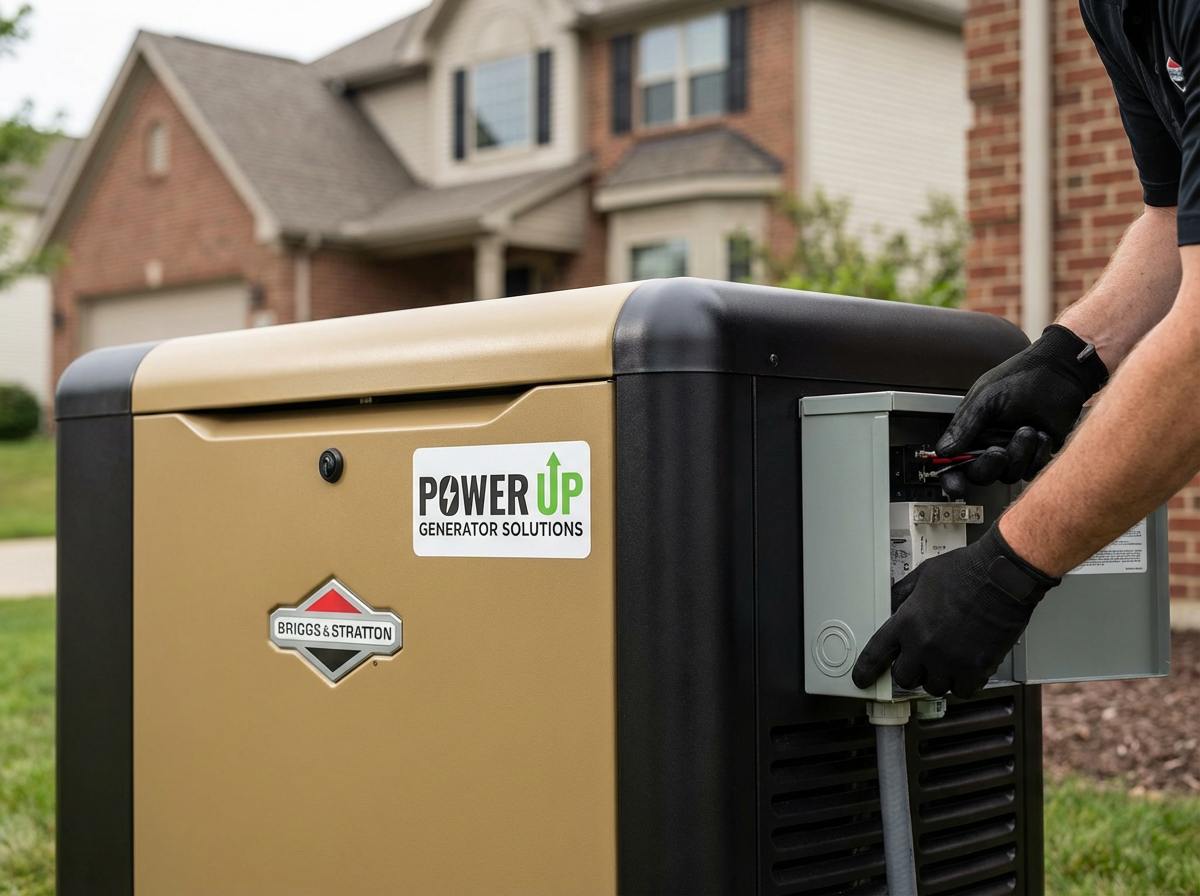
Automatic home standby generators — installed permanently outdoors by licensed technicians — virtually eliminate the CO risks associated with portable generators. Here is why:
- They are permanently mounted outdoors in weatherproof enclosures — never moved indoors
- Exhaust systems are installed pointing away from the home, following local code requirements
- The automatic transfer switch means you never need to run extension cords or place the generator near windows
- Installation meets NFPA 70 (National Electrical Code) requirements, including clearance from structures
- Our factory-trained technicians inspect clearances, exhaust direction, and enclosure integrity at every annual service visit
If you are concerned about CO safety during outages, the most effective solution is a professionally installed standby generator. The upfront investment eliminates years of risk from operating portable units.
New CO Shutoff Technology in Modern Generators
Many newer portable generators now include CO-MELT technology or automatic shutoff sensors that detect elevated CO levels and shut down the engine before dangerous concentrations can build up. Generac's CO-SENS technology and Honda's CO-MINDER are examples. While helpful, these features are not a substitute for proper placement — they are a safety net, not a solution. Always place generators at least 20 feet from any opening.
Frequently Asked Questions
Can a generator give off carbon monoxide outdoors?
Yes. Even outdoors, a generator can create dangerous CO concentrations near open windows, doors, vents, and air conditioning intakes. A generator must be placed at least 20 feet from any opening into your home, with the exhaust directed away from the structure. Wind can carry exhaust back toward the house even from a distance — always check wind direction when placing a generator.
What are the symptoms of generator carbon monoxide poisoning?
Early CO poisoning symptoms include headache, dizziness, weakness, upset stomach, vomiting, chest pain, and confusion. These symptoms are often mistaken for the flu. The critical difference: CO symptoms affect everyone in the building at the same time, and pets are affected first (they are more sensitive). If multiple people feel sick simultaneously, get everyone outside immediately and call 911.
Can I run a generator in my garage with the door open?
No. The Consumer Product Safety Commission (CPSC) warns that even running a generator with the garage door fully open is dangerous because CO can still enter your home through the door connecting the garage to the living space. Generators must be operated outdoors, completely outside the garage, at least 20 feet from any opening.
Where should I place a CO detector for generator use?
Install battery-operated CO detectors on every level of your home, especially near sleeping areas. The CPSC recommends detectors within 15 feet of every bedroom door. Do not rely on CO detectors alone as a substitute for proper generator placement — detectors alarm when CO is already present, not before. Proper placement prevents CO from entering the home at all.
Do standby generators produce as much carbon monoxide as portable generators?
No. Automatic standby generators installed by licensed technicians are permanently mounted outdoors in manufacturer-approved enclosures, with exhaust systems properly directed away from the structure. Portable generators are far more likely to be involved in CO incidents because people improperly run them indoors, in garages, or too close to the house. Standby generators eliminate almost all CO risk through their permanent, code-compliant installation.
Eliminate CO Risk with a Professionally Installed Standby Generator
Power Up Generator Solutions installs Generac, Cummins, and Briggs & Stratton standby generators according to all safety codes. As a 501(c)(3) nonprofit, we offer dealer-cost pricing — saving you $2,000–$4,000 vs. for-profit dealers.
Call or text: 816-461-9751 | 816-785-1268 (text)